For a firm driveway or busy path, a suitable dense-graded crushed-limestone mix is usually a better starting point than loose pea gravel. The angular particles and mix of sizes can form a more stable surface when installed correctly. Pea gravel has a softer, rounded look that works well in contained decorative areas, but it can shift under tires and feet. For drainage, check the actual grading and fines rather than choosing by appearance.
One important wrinkle: clean, open-graded crushed limestone is different from crusher run. It contains fewer fines and does not pack into the same dense surface. That’s why a fair comparison needs to name the actual limestone product.
Crushed limestone vs pea gravel at a glance
| What matters | Crushed limestone | Pea gravel |
|---|---|---|
| What the name describes | Limestone source rock that has been mechanically crushed; the product may be screened, washed or blended | Small, usually rounded gravel; the underlying rock can differ by source |
| Particle shape | Typically angular, with fractured faces | Typically smooth and rounded |
| Grading and fines | Varies widely: dense-graded blends with fines or cleaner, more uniform-sized stone | Often screened small gravel with relatively little fine material; confirm the actual product |
| Firmness under traffic | Suitable dense-graded products can form a comparatively firm layer with correct placement and support; clean stone differs | Often stays loose and can move under concentrated foot or wheel loads |
| Compaction | Depends on grading, fines, moisture, equipment and subgrade—not just angularity | Particles can settle and pack closer, but rounded uniform particles generally offer less interlock as a stable wearing surface |
| Water movement | Clean, open grades can drain readily; dense grades with fines may pass water more slowly | Clean, open-void products can pass water; drainage also depends on soil, filter and outlet |
| Appearance | Often gray, cream or pale limestone tones; dust and grading affect the finish | Often mixed earth tones or supplier-specific colors, with a rounded texture |
| Walking comfort | Fine, well-finished crushed blends can feel firmer; coarse chips can be uncomfortable | Smooth individual stones may feel less sharp but a loose bed can be tiring to walk on |
| Confinement | Edging may still be necessary, especially with exposed loose stone | Effective edging is especially useful where small round particles migrate |
| Driveways | Specified crushed aggregate is commonly considered for supporting and wearing courses | Usually a poor default for an unconfined, frequently driven surface |
| Gardens and patios | Useful as a specified base, a contrasting decorative cover or a suitably selected compacted path | Popular as a loose decorative cover or contained patio surface; not automatically an appropriate paver base |
| Upkeep | May need regrading; fine blends may produce dust or track fines | May need raking, topping up and cleanup outside edging |
| Buying comparison | Confirm precise grade, bulk density and whether price is per US short ton or cubic yard | Confirm actual stone, screening/washed status, density, unit and delivery charges |
Important distinction: This table compares common product characteristics, not two uniform national specifications. A supplier’s product sheet and the proposed use take priority over generalized labels.
What is crushed limestone?
Crushed limestone is limestone bedrock broken into aggregate and then graded for sale. The crushing process ordinarily creates angular faces. Screening separates sizes; washing can remove fines; blending produces a range of sizes for a specified use. A supplier could sell several very different materials under the broad name “crushed limestone.”
For this comparison, distinguish two common categories:
- Dense-graded crushed limestone: a mixture of coarse and smaller pieces, including controlled fine particles. A suitable product can be compacted into a tighter, load-supporting layer when placed over adequate ground support.
- Clean or open-graded crushed limestone: screened stone with relatively few fines. The larger connected voids can be useful where a design needs water to move through the layer, but it may remain visibly stony instead of forming a smooth, tightly packed finish.
Those descriptions do not specify a universal top size, fines percentage or strength. A product labeled “crusher run” often contains fines, but not every crushed-limestone product is crusher run. A local number such as “#57” is meaningful only with the supplier’s cited gradation or applicable specification. See our crushed limestone driveway guide for the separate questions involved in designing base and surface layers.
What is pea gravel?
Pea gravel generally means small, rounded gravel particles, often recovered from naturally weathered deposits and then screened. It is a size-and-shape shopping term, not the name of a single rock type. Some suppliers may offer a narrow size range and mixed colors; others may sell a somewhat larger or smaller screened blend.
For context, the USDA Natural Resources Conservation Service (NRCS) describes small rounded gravel in the approximate 1/8–3/8-inch range as sometimes being called pea gravel. That is not a nationwide retail-product guarantee. Verify the exact size range and whether the delivered material is washed, contains fines or includes partly fractured pieces.
Individual stones may feel smoother to a hand or bare foot than coarse angular chips. But smooth stones can also roll against each other, so the walking surface as a whole may feel less secure than a suitably compacted path.
Particle shape: angular vs rounded stone
Angular aggregate tends to make more irregular stone-to-stone contacts. With suitable grading and confinement, those contacts help particles resist sliding against one another. Rounded particles can rearrange more easily under movement. FHWA identifies angular, approximately cubical particles as desirable for many granular base applications, and notes that gradation and the amount of fines also affect stability.
That does not mean a pile of clean angular stone behaves like a finished compacted aggregate base. Fines and smaller grains can help fill voids in a dense-graded mixture, while a uniformly sized clean stone keeps a more open internal structure. Similarly, rounded pea gravel can settle or become more densely packed without developing the same kind of stable interlocking surface as an appropriate angular, graded mix.
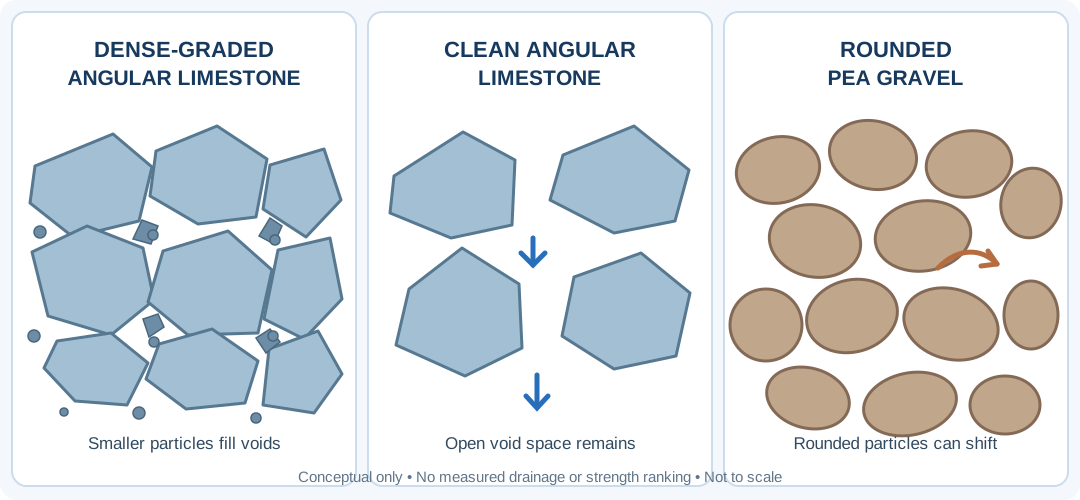
Which material forms a more stable surface?
For a repeatedly traveled, firm loose-aggregate surface, an appropriately specified and installed dense-graded angular product generally has the advantage. It can achieve close packing because smaller particles fill spaces between larger ones. The USDA NRCS guide favors suitably compacted crushed rock with fines for several trails and access-surface applications, while warning that rounded gravel can move under traffic. These are engineering principles, not a ready-made residential layer design.
The three cases should not be confused:
- Dense-graded angular limestone: potentially a compactable surface or base if its exact grading, compaction and foundation conditions fit the use.
- Clean angular limestone: potentially useful in an open-graded layer; it may resist movement through angular contact but not create the same tight finished surface.
- Rounded pea gravel: readily rearranged at the surface; fine for many confined decorative uses but generally less suited to concentrated repeated wheel loads.
A thin layer over wet clay will not become a durable driveway simply because its stones are angular. The underlying soil, drainage, thickness, maintenance and installation method are parts of the system.
Which material is better for drainage?
Look at the spaces between particles, not only the material name. Clean, relatively uniform-sized aggregate can have connected voids that allow water to pass. A dense-graded mixture contains smaller particles that occupy many of those voids. FHWA states that grading has a marked influence on aggregate permeability and notes that open-graded materials may be both angular and free-draining.
So neither statement is reliable: “limestone never drains” or “pea gravel always drains better.” Even clean stone is not a working drainage system by itself.
A drainage assembly may also need a suitable filter or separation material, compatible surrounding soil, proper slope or hydraulic design and an actual outlet. Fine soil can migrate into a coarse layer and clog its voids unless the filter details are appropriate. A product recommended for one perforated-pipe system is not automatically correct for every French drain, foundation drain or infiltration feature. If the installation has engineered specifications, follow the specified aggregate grading and filter requirements rather than substituting by appearance.
Crushed limestone vs pea gravel for driveways
For a driveway that regularly carries vehicles, a properly selected crushed-aggregate base or surface is commonly the stronger starting candidate. Dense-graded limestone products may be appropriate for a compacted course; clean angular stone may have a different, explicitly specified role. Pea gravel is not a good default for an unconfined driving surface: turning wheels can displace rounded particles, producing tracks or movement toward the edges.
Before choosing, consider wheel loads (including delivery trucks), turning points, steep grades, native soil, standing water, edge support and whether the top course is intended to be compacted or loose. Both material choices can require periodic maintenance; one layer of either is not a substitute for preparing the ground and managing runoff.
For actual layer selection, see Crushed Limestone for Driveways: Choosing Base and Surface Materials. This comparison deliberately does not prescribe a universal driveway depth.
Which is better for walkways and garden paths?
A compactable fine crushed aggregate may provide a firmer route for daily use, wheelbarrows and garden carts if properly installed. Rounded pea gravel can work for a relaxed, decorative path with dependable edging, but shoes, cart wheels and furniture legs may sink or push stones aside. Clean coarse limestone may feel rougher underfoot than either a finer compacted finish or rounded individual pebbles.
Slope and maintenance matter. On a sloping or narrow path, displaced particles may need frequent raking. A cart route, primary entrance or walkway intended for people with mobility limitations deserves a specifically designed firm, stable, slip-resistant and accessible surface. Do not assume that an ordinary loose-stone path meets accessibility requirements just because it looks level. Consider a different surfacing system when dependable mobility access is necessary.
The University of California Master Gardener program likewise distinguishes loose rounded gravel from compactable angular path materials; the particular product and installed depth still matter.
Which is better for patios?
First decide whether you want a loose gravel patio or a paved patio with pavers. They are different projects.
For a contained loose decorative patio, pea gravel provides a rounded appearance, but chairs and tables can wobble or settle. Well-planned edging and furniture support are practical considerations. An appropriately selected compacted angular aggregate can offer a firmer loose-aggregate patio finish, although coarse pieces and dust may be drawbacks.
For interlocking concrete pavers, neither generic “pea gravel” nor generic “crushed limestone” tells you which base and bedding to install. Follow the paver manufacturer’s current system specification, which may distinguish dense-graded bases, open-graded bases, specified bedding sand and particular clean crushed-stone sizes. The Concrete Masonry & Hardscapes Association (CMHA) describes standard sand-set and open-graded constructions as different assemblies with important limitations. Do not replace specified bedding with whatever small stone is available.
Landscaping and decorative uses
For a visible garden border or bed, appearance and containment often matter more than compacted strength. Pea gravel is commonly chosen for rounded texture and mixed colors; some limestone aggregates provide a brighter, more uniform stone color. Review a local sample in daylight, preferably wet and dry, rather than relying on a web photo.
Consider nearby lawns and mower throw, leaf cleanup, planting access, weed growth, irrigation, drainage discharge and how easily you can retrieve scattered stones. Both products can be carried into grass or onto adjacent paving. Neither is automatically a weed barrier or a substitute for soil and plant management.
Avoid assuming that every limestone aggregate will meaningfully change the pH of an entire garden bed. The effect depends on the stone, soil chemistry, water and exposure, and this article does not establish a plant-specific recommendation. Ask a horticultural professional before using mineral aggregate around sensitive planting.
Crushed limestone vs pea gravel cost
There is no dependable nationwide price winner. The delivered bill depends on local pits and quarries, the particular grade, ordered amount, bagged versus bulk packaging, truck access, minimum loads and distance to the property. Price pages that list generalized ranges may not describe a supplier’s actual available product or current delivered quote.
Always align the sales units:
- US short ton: 2,000 pounds of material sold by weight.
- Cubic yard: 27 cubic feet of bulk volume.
- Bulk density: required to compare a per-ton quote with a per-yard quote. The relevant density can differ by product, moisture and whether the measurement refers to loose or compacted material.
- Delivered total: material cost plus haulage, minimum-order surcharges, taxes and any placement fees.
Illustrative math only—not market prices or assumed real product density: Suppose one supplier offers limestone at $45 per US short ton, with a hypothetical supplier-confirmed loose bulk density of 1.35 short tons per cubic yard. Two cubic yards would be 2 × 1.35 = 2.70 short tons, or $121.50 before delivery. Another supplier hypothetically quotes pea gravel at $70 per cubic yard, so two cubic yards would be $140 before delivery. These numbers only demonstrate a unit comparison. Replace every price and density with the actual supplier’s figures before making a purchasing decision.
Do not compare a compacted final layer volume directly with a loose delivered cubic yard without checking how the supplier expresses its conversion.
How much material do you need?
Here is a volume example, not a recommended layer thickness. Imagine a rectangular area 20 feet long × 10 feet wide, with a hypothetical 3-inch layer:
- Area = 20 × 10 = 200 square feet.
- Depth = 3 ÷ 12 = 0.25 feet.
- Geometric volume = 200 × 0.25 = 50 cubic feet.
- Cubic yards = 50 ÷ 27 ≈ 1.85 cubic yards.
That volume is at the stated measured layer depth. It is not automatically the loose quantity to order for a compacted finish. Turning it into US short tons requires the actual material-specific loose bulk density and a consistent loose/compacted volume basis. Crushed limestone and pea gravel must not be assigned the same density without evidence.
Once you have selected limestone and checked the supplier’s numbers, use the Crushed Limestone Calculator to estimate volume and weight. This tool is for limestone estimates; do not treat its default assumptions as verified pea-gravel density values.
Which should you choose? Practical decision guide
| Your project | What matters most | Candidate to investigate | Limit / question to ask |
|---|---|---|---|
| Decorative garden bed | Appearance, cleanup, planting and edging | Pea gravel or decorative screened limestone | What size, color and edging will keep stones out of lawns? |
| Occasional-use garden path | Foot comfort, slope and stone migration | Contained pea gravel or finer compactable crushed aggregate | Will carts use it; is the surface stable enough? |
| Frequent-use or accessible route | Firmness, stability and accessibility specification | Designed, properly graded stable surfacing system | Does the complete installed system meet applicable access needs? |
| Driveway support course | Vehicle loads and subgrade support | Project-specified compacted crushed aggregate base | What grading and installation specification applies? |
| Exposed driveway surface | Rutting, turning, traction and maintenance | Suitable dense-graded angular limestone or designed alternative | What is the local wearing-course recommendation for this soil and traffic? |
| Specified drain or infiltration feature | Void structure, filters, soil and outlet | Drainage aggregate meeting the actual system specification | Is its gradation filter-compatible and approved for this assembly? |
| Interlocking-paver base / bedding | Complete paver manufacturer assembly | Precisely specified base and bedding materials | What product gradations and construction layers are required? |
| Loose decorative patio | Furniture support, edging and comfort | Contained pea gravel or appropriate compactable finish | Will furniture remain level, and what maintenance is acceptable? |
| Landscape edging strip | Containment, appearance and mower safety | Decorative gravel or limestone with a restraint | Where can pieces migrate, and how will you clean around them? |
These are product-selection starting points. Engineered, code-governed, playground and accessibility-critical installations need their own applicable standards and installation details, not a recommendation based on a material nickname.
Questions to ask before ordering
Bring a sketch with dimensions, a description of the actual traffic and a picture of the ground conditions. Then ask the supplier or installer:
- What exact product name and source rock will appear on the ticket? Is it crushed limestone or rounded natural gravel?
- What is the size range and grading? Can you provide a sieve analysis or written product specification?
- Is this product washed or clean, or is it dense-graded with fines?
- Is the exact product suitable for my driveway base, top course, path, patio or specified drainage system?
- What is its loose bulk density in pounds per cubic yard or US short tons per cubic yard, and under what moisture condition?
- Is the quote per US short ton, per cubic yard, per bag or per truckload?
- What are the minimum order, delivery fee, surcharge and truck access requirements?
- Does the installation need edge restraints, a specified compacted base, a filter/separation layer or another drainage component?
- If my final depth is specified as compacted, how should I convert it to the supplier’s loose delivered quantity?
- Can I inspect a representative sample, not just the marketing name?
Common material selection mistakes
- Equating crushed limestone with crusher run. Clean and dense-graded limestone are not equivalent.
- Treating a rounded appearance as proof of better drainage. Actual gradation and fines content control much of water movement.
- Ignoring the surface beneath the rock. Wet, weak soil can undermine a reasonable aggregate selection.
- Choosing a decorative stone for regular wheel loads. Loose pea gravel can move under tires and carts.
- Skipping edging and confinement. Small particles can scatter into grass, planting beds or drains.
- Comparing unlike price units. A ton quote and a yard quote require a valid bulk-density conversion.
- Using a universal tons-per-yard number. Density must match the specific material and its condition.
- Treating stone as a complete pavement system. Subgrade, base, filters, bedding and outlets have separate jobs.
- Ignoring local rules or manufacturer requirements. Paver assemblies, access points and engineered drainage may have mandatory details.
Frequently asked questions
Is pea gravel suitable for a driveway?
It is generally a poor default for an unconfined driveway surface because rounded small particles can migrate under tires. A professionally designed stabilized or confined system may use different components; do not assume a loose layer will perform the same way.
Does pea gravel drain better than crushed limestone?
Not always. A clean open-graded crushed limestone may be highly permeable; a dense-graded limestone blend with fines may be less so. Washed pea gravel can transmit water through voids, but overall drainage depends on soil, filters and outlets.
Which is more comfortable for walking?
Individual rounded pea-gravel stones feel smoother, but a deep loose layer can be harder to walk or push a cart through. A fine, well-compacted crushed path can feel firmer. Test a representative sample and consider accessibility needs.
Can crushed limestone be used around a French drain?
Possibly, if the exact clean aggregate meets the drainage design’s gradation and compatibility requirements. Dense-graded limestone with fines is not equivalent to clean drainage stone. The system may also need a specified filter, separation and outlet.
Is pea gravel cheaper than crushed limestone?
There is no reliable national rule. Compare delivered totals from local suppliers using the same quantity basis and appropriate bulk-density conversion.
How much does one cubic yard weigh?
There is no single safe figure for both products. One cubic yard is 27 cubic feet, but its weight depends on the exact aggregate, grading, moisture and loose/compacted state. Obtain the supplier’s matching bulk density to calculate pounds or US short tons.
Before you order: ask for the exact grade and compare delivered prices. For a compactable base, start with a specified dense-graded material; for a contained decorative finish, consider pea gravel; for a drain, follow the drainage-system specification.