For a conventional interlocking concrete paver patio, walkway or driveway built to Concrete Masonry & Hardscapes Association (CMHA) guidance, choose properly graded concrete bedding sand—not generic stone dust or limestone screenings. The CMHA guide specification, Section 2.03, explicitly excludes stone dust and masonry sand from this bedding application and calls for bedding sand meeting its specified gradation. A brand-name bag of “paver sand” is not enough evidence by itself: verify what the sand is intended to do.
That advice is specific to conventional sand-set interlocking concrete pavers. Other approved systems may use open-graded stone chips, mortar or proprietary bedding. Use the installation detail for your pavers—not a material substitution based on a similar-looking patio.
Stone Dust vs Bedding Sand at a Glance
| Material | What it usually means | Intended role | Moisture and fines consideration | Under conventional interlocking concrete pavers? |
|---|---|---|---|---|
| Stone dust / quarry fines | Very fine crushed-rock byproduct; rock and grading vary | Only when a separate project specification calls for it | May contain substantial No. 200 fines; compaction and water movement vary | No as a generic substitution. CMHA PAV-TEC-002 and 009 discourage/exclude it. |
| Limestone screenings | Screened crushed-limestone particles, sometimes fine chips down to dust | Supplier-specific applications, not a universal bedding product | Can be fine-rich and susceptible to breakdown in certain loading conditions | Do not substitute. Check CMHA 009, 017 and exact system specification. |
| Specified concrete bedding sand | Clean, appropriately graded natural or manufactured sand; commonly ASTM C33 gradation plus CMHA limits | Thin setting course above the compacted base | Controlled grading, shape, fines and durability matter | Yes when the project specifies that bedding sand and the delivered product conforms. |
| Masonry / mason sand | Sand supplied for mortar, often associated with ASTM C144 | Masonry mortar; may be approved for some joint-filling work | Finer grading can retain more moisture and perform differently | No as the bedding substitution in CMHA 009. |
| Ordinary joint sand | Sand selected to fill gaps between laid pavers | Interlock and joint filling | Must fit joint width and project requirements | Not automatically bedding sand; some specified bedding sands can also serve as joint sand. |
| Polymeric joint sand | Joint-filling sand with binders and product-specific activation instructions | Approved joints between laid pavers | Installation depends on the product's moisture and joint-depth instructions | No unless a manufacturer explicitly designs it as bedding. |
Why the “no” matters: CMHA PAV-TEC-002 describes the conventional bedding material as concrete sand and says not to use masonry sand, limestone screenings or stone dust. CMHA PAV-TEC-010 distinguishes the finer sand acceptable in some joints from sand appropriate under the units.
What Is Stone Dust?
Stone dust is a trade name for fine particles generated when larger rock is crushed and processed. At one yard, “stone dust” may mean a powder-rich byproduct; elsewhere, “screenings” may include small angular chips blended with fines. The source may be limestone, granite or another rock. The label alone tells you neither the exact particle-size distribution nor performance.
Fines are very small particles; the No. 200 sieve has openings of 0.075 millimeters. The percentage passing that sieve helps characterize very fine material, but neither a single sieve number nor the rock name provides a complete durability or permeability test. Washed-sieve testing may also be needed to measure that fraction accurately: the public ASTM C136/C136M method summary refers to ASTM C117 for the material finer than No. 200.
Stone dust may be sold damp or dry, loose or compacted, and in gradations with different bulk densities. These are separate purchasing and estimating properties. A pile that compacts tightly is not automatically approved paver bedding, structural base, or drainage aggregate.
What Is Paver Bedding Sand?
Bedding is the relatively thin course between the specified base and the concrete paving units. In a conventional sand-set interlocking pavement, appropriately graded sand provides a uniform seat for pavers and is involved in the compaction and interlock process. It should not act as a patch for ruts or low spots in an incorrectly finished aggregate base.
CMHA generally specifies clean, non-plastic, appropriately shaped natural or manufactured sand with the relevant ASTM C33 concrete-aggregate gradation and CMHA’s additional grading limits. That means manufactured sand produced from crushed rock can qualify if it meets the specification; it does not mean every crushed-rock dust product qualifies. Ask the supplier for the actual sieve-analysis report, including the required fine fraction, rather than trusting a product name.
For the conventional construction described in CMHA PAV-TEC-009, Section 3.04, the sand is screeded to a nominal uncompacted 1-inch thickness. That is a cited example for this system, not a thickness recommendation for porcelain, natural stone, permeable pavers or every slab. Confirm the specific system drawing and the required loose-versus-compacted measurement.
Why Stone Dust Is Not Recommended Under Conventional Concrete Pavers
Several material characteristics can make a fine-rich crushed-rock product a poor substitute for specified bedding sand.
1. Excess fines can restrict water movement
CMHA’s construction guidance warns that waste screenings and stone dust may inhibit lateral drainage of moisture in the bedding layer. This does not mean all stone dust is waterproof. It means the combination of fine particles, packing, and drainage detail may keep a bedding layer wetter than intended.
2. Gradation is a performance requirement, not a marketing label
A properly selected bedding sand must conform to the applicable grading requirements. A product that looks gritty or compacts into a flat surface may contain too much of the wrong fraction. In the CMHA guide specification, ASTM C33 governs bedding gradation, while ASTM C144 is cited in the separate joint-sand context; stone dust itself is explicitly excluded.
3. What looks firm at first may not stay firm
A freshly screeded dust layer can feel solid, yet its particles may break down or shift under repeated loading and moisture. CMHA’s vehicular bedding guidance calls attention to abrasion and particle durability. A level-looking bed also cannot correct an uneven aggregate base. These are reasons to specify and test bedding material—not a prediction that every existing stone-dust patio will fail.
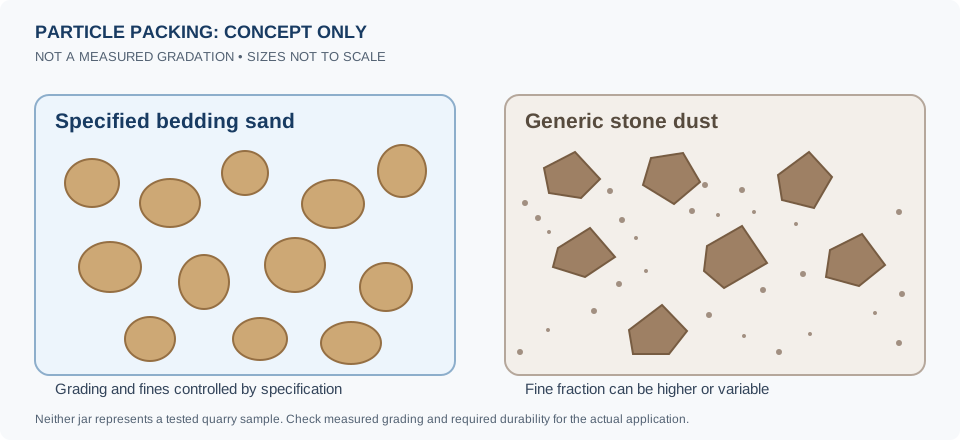
Stone Dust vs Concrete Sand
Concrete sand describes sand suitable for concrete-related specifications and, in the relevant CMHA assembly, the specified paver bedding grading. Sand can be quarried naturally or manufactured by crushing durable rock. Stone dust usually describes much finer crushed material, with highly variable grading and quality.
The distinction is not “sand is natural and dust is crushed.” Instead, compare the submitted material against the specified grading curve, fines limit, particle characteristics and any durability criteria. ASTM C33/C33M itself covers natural and manufactured fine aggregates for concrete. CMHA uses that gradation reference in a pavement bedding specification; the ASTM concrete-aggregate standard alone is not a complete guarantee of bedding suitability.
The same quarry may sell clean, well-graded manufactured concrete sand and fine screenings. They should be evaluated as different products.
Stone Dust vs Masonry Sand
Masonry sand is selected for masonry mortar or related applications. The current public ASTM C144 abstract explicitly describes aggregate for masonry mortar; it is not a standalone interlocking-paver bedding specification. It is usually finer than bedding-grade concrete sand.
CMHA PAV-TEC-009, Section 2.03 says not to use mason sand or sand conforming to ASTM C144 for bedding. That does not make masonry sand “bad sand.” It means the right grading depends on the job. Joint sand for some interlocking pavers may conform to C144 even though the material is excluded from the bedding layer.
Bedding Sand vs Joint Sand: Two Different Jobs
- Bedding sand goes underneath conventional interlocking concrete pavers, on top of the prepared base. It gives the units a controlled setting course.
- Joint sand goes between the installed units. Its grain size must work with the joint width and installation method. Some conventional joint sands can meet ASTM C144; suitable bedding sand may also work for certain joints under CMHA guidance.
- Polymeric sand is a joint-filling product, not the standard under-paver bedding layer. Its binders and instructions are specific to the selected product and paver system.
For example, Belgard’s installation overview places bedding sand below its pavers and describes polymeric sand as a material swept into the joints afterward. Never assume “paver sand” means the same layer in every bag or supplier catalog.
What Goes Under Pavers? Understanding the Layers
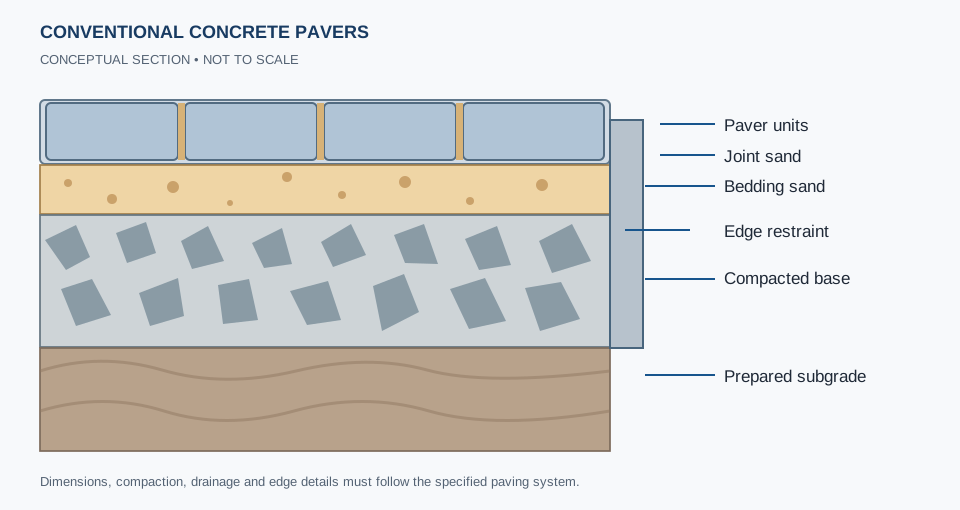
- Prepared subgrade: the underlying soil must provide adequate support and be prepared for site conditions.
- Specified compacted aggregate base: a load-supporting course built to the project’s base specification. A dense-graded base may intentionally contain controlled fines—unlike a bedding course.
- Specified bedding sand: a thin, even setting bed above the compacted base, for conventional sand-set systems.
- Paver units: the chosen concrete products, installed to their required pattern, joints and tolerances.
- Joint-filling material: suitable sand or approved proprietary joint product between pavers.
- Edge restraints and drainage: design-dependent supporting elements that keep units confined and water managed.
The bedding course is not the whole “paver base.” Poor subgrade preparation or uneven compacted base cannot be repaired by making the bedding sand thick. The CMHA construction guide and Belgard installation overview explain those layer roles.
Does Stone Dust Drain Better Than Sand?
There is no dependable yes-or-no answer based on product names alone. Clean, appropriately graded concrete bedding sand typically has different water-movement behavior from fine-rich quarry dust; CMHA warns that excess fines can inhibit lateral drainage in conventional bedding. But permeability depends on the measured gradation, how particles pack, compaction and moisture—not simply whether the source rock is limestone.
Equally important, a free-draining layer cannot solve a pavement with no route for water to exit. Surface slope, compacted-base behavior, soil infiltration, outlets, edge drainage and local climate all affect the whole system. For a site with persistent standing water or frost-sensitive soils, get a system-specific drainage design rather than relying on the word “draining” in a product description.
Can You Use Limestone Screenings Under Pavers?
Do not substitute generic limestone screenings for conventional interlocking-concrete-paver bedding specified under CMHA guidance. CMHA PAV-TEC-002 states that limestone screenings or stone dust should not be used in this bedding course. CMHA PAV-TEC-017 adds loading- and durability-related cautions for vehicular systems.
Why do some suppliers recommend them? The Gravelshop paver guide, for example, describes screenings as a possible bedding choice in some local practices, while also noting potential water-retention concerns. That is a description of supplier practice—not a replacement for the specified assembly. If a product manufacturer supplies a different tested or approved detail, ask for it in writing and verify the exact screenings, paver model, intended loads and drainage conditions. Do not infer approval from a supplier’s general “paver base” label.
What About Permeable Pavers and Other Paving Systems?
“Pavers” covers more than one assembly:
- Conventional interlocking concrete pavers: CMHA’s typical sand-set assembly uses specified concrete bedding sand over an appropriate base.
- Permeable interlocking concrete pavement: CMHA’s 2025 U.S. guide specification PAV-GSP-016 describes an open-graded crushed-stone bedding layer, commonly ASTM No. 8, over compatible open-graded reservoir aggregate. PAV-TEC-018 separately describes stone in the permeable joints. Stone dust is not a substitute for this clean, open-graded aggregate.
- Segmental concrete slabs and planks: CMHA PAV-TEC-025 describes sand-set and other setting systems and cautions against stone dust for its sand-set bedding. Size and loading can change the allowable construction detail.
- Natural stone, porcelain and proprietary systems: options may include approved mortar, bonded construction, pedestals or a specified chip bedding. A concrete-paver installation diagram is not an installation instruction for those products. Obtain the exact manufacturer’s detail before choosing materials.
Unilock’s patio installation instructions illustrate how even a manufacturer can distinguish sand bedding and small-chip bedding for different base systems; they also warn against limestone screenings and mason sand in the conventional context. A different approved material is not the same as unsorted fines.
What If Stone Dust Is Already Under Your Pavers?
Do not automatically assume every existing patio must be removed. Also do not assume that a currently level surface proves it will remain stable.
- Identify the pavers and assembly. Look up the model, product literature, date of installation and any approved alternate bedding detail.
- Identify the installed material. Was it fine quarry dust, graded screenings or a specified chip product? Find an invoice, gradation sheet or retained sample if possible.
- Inspect symptoms. Photograph settlement, rocking units, recurring puddles, washout, joint loss or changes after rain and freeze-thaw cycles.
- Review drainage and loading. A pedestrian patio, a driveway and a heavily used turning area face different stresses.
- Check warranty terms. Eligibility depends on the named manufacturer, model, installation rules and written policy; do not assume a blanket void.
- Get a qualified inspection when needed. Meaningful settlement, tripping edges, persistent moisture or vehicular loading warrant professional evaluation before a localized repair or rebuild decision.
If an installer proposes leaving the existing installation in place, request the technical rationale, condition assessment and any written manufacturer acceptance.
How Much Bedding Material Do You Need?
First choose a material that the relevant installation specification actually permits. Then calculate geometric volume based on your measured area and the specified layer thickness.
Hypothetical example only—not an installation thickness prescription:
- Rectangular area: 10 ft × 15 ft = 150 square feet.
- Assumed bedding thickness for arithmetic: 1 inch = 1/12 foot.
- Geometric volume: 150 × (1/12) = 12.5 cubic feet.
- Convert to cubic yards: 12.5 ÷ 27 = approximately 0.463 cubic yards.
This is the in-place geometry of the hypothetical layer, not a final truck order. Confirm whether your project specifies screeded/uncompacted or finished thickness; suppliers may sell loose cubic yards, bags or tons. To estimate weight, use a supplier-provided bulk density for the chosen bedding material and its actual loose or compacted moisture state. Do not borrow a stone-dust density to calculate bedding sand.
Is There a Use for Stone Dust Outside Paver Bedding?
Yes, where a project expressly specifies a particular fines-containing material. Selected compacted surfacing, engineered aggregate mixes or manufacturer-defined landscape products can use fine crushed rock in suitable roles, but those are different designs. Ask for the actual material definition and intended application rather than assuming any product called “stone dust” works for every path, slab or base.
If a separate approved project really does call for stone dust, the Stone Dust Calculator can help estimate volume, weight, bags and cost using disclosed assumptions. That quantity tool does not recommend stone dust beneath conventional interlocking concrete pavers or validate its engineering suitability.
How to Choose the Correct Bedding Material
Take the paver product information and ask the manufacturer or supplier these questions before purchasing:
- What exact paving system and product model am I installing—standard interlocking, permeable, slab, natural stone or another system?
- Which published manufacturer detail applies to my pedestrian or vehicle loads, climate and base type?
- What is the required bedding material, and does this specific local product meet it?
- Can you supply a gradation report showing material passing the No. 200 sieve, plus any other required limits? Was the fine fraction measured appropriately?
- Is the offered product concrete sand, masonry sand, stone dust, limestone screenings, or a named chip aggregate?
- Are durability or degradation tests required for this vehicular application? Who approves the results?
- What is the required bedding thickness and measurement state (loose or compacted)?
- Where will water drain, and are special base, edge or underdrain details required?
- Does the actual product warranty or installation document approve the proposed assembly?
- Is the supplier pricing loose cubic yards, bags, US short tons or metric tonnes? What density basis and delivery allowances should be used?
Where a test report is requested, note that ASTM C136/C136M concerns sieve analysis and its public summary refers to ASTM C117 washing for accurate very-fine-particle determination. Do not ask a quarry to certify compliance solely from a visual sample.
Common Material-Selection Mistakes
- Calling every layer “paver base.” The compacted base, setting bed and joint material do different jobs.
- Selecting dust because it compacts firmly. Compaction alone does not demonstrate bedding gradation, water behavior or durability.
- Replacing concrete sand with mortar sand. ASTM C144 serves a different specification context.
- Pouring polymeric joint sand under pavers. A joint-filling formulation is not bedding material.
- Treating all pavers alike. Standard concrete pavers, permeable systems and natural stone can have different approved details.
- Assuming source rock proves quality. Two limestone products can have radically different grading, durability and fines content.
- Accepting an unsupported supplier substitution. Ask for the system manufacturer’s written approval and relevant gradation.
- Using stone dust density for sand. Bulk density changes with the material, grading, moisture and measurement state.
- Ignoring drainage and the underlying base. The best bedding choice cannot repair poor subgrade support or missing water outlets.
Frequently Asked Questions
Can I use stone dust instead of bedding sand?
Not as an unapproved substitute in conventional interlocking concrete paving under CMHA PAV-TEC-009. Use the bedding material required by the actual product/system specification.
Is masonry sand suitable under interlocking concrete pavers?
CMHA’s guide specification excludes ASTM C144 masonry sand as conventional bedding sand. It may be suitable for certain joints, subject to joint-width and project requirements.
What is the difference between bedding sand and joint sand?
Bedding sand sits below the paver units and forms their setting course. Joint sand fills the gaps between units after placement. Different gradation and installation requirements can apply.
Can polymeric sand go under pavers?
It is normally supplied for joints, not bedding. Do not put it beneath units without an explicit product/system instruction approving that use.
What bedding material do permeable pavers use?
A common CMHA permeable interlocking system uses open-graded angular aggregate, often ASTM No. 8 stone, as bedding rather than ordinary concrete sand. Follow the precise permeable design; stone dust is not equivalent to open-graded aggregate.
What if stone dust is already installed under my pavers?
Document the actual system, surface condition, water behavior and expected loads. Check the manufacturer details and have a qualified installer evaluate significant problems before deciding on repair or replacement.
How do I calculate bedding quantity?
Multiply area in square feet by specified bedding depth in feet to get cubic feet; divide by 27 for cubic yards. For a hypothetical 150-square-foot area at 1 inch, that is 12.5 cubic feet or about 0.463 cubic yards, before ordering adjustments.
Check your paving-system instructions: CMHA’s guidance describes conventional interlocking concrete paving, while other approved systems may require different bedding. Use the current specification for your product and expected loads.